

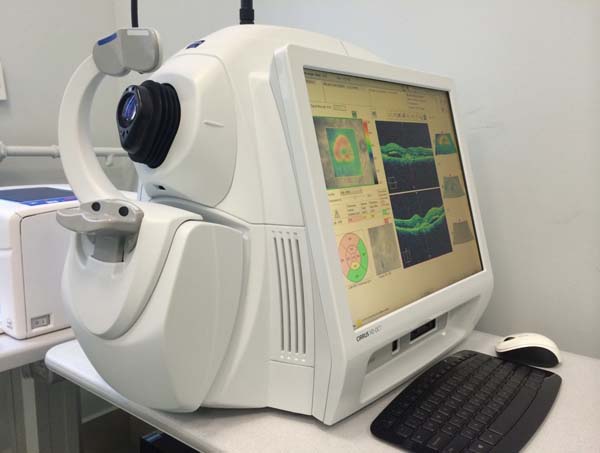
Carl Zeiss Cirrus HD-OCT 5000
The Carl Zeiss CIRRUS HD-OCT 5000 is a state-of-the-art optical coherence tomography (OCT) system designed for high-resolution imaging of the retina, optic nerve, and anterior segment. Combining advanced imaging technology with intuitive software, the CIRRUS HD-OCT 5000 enables ophthalmologists and optometrists to obtain precise, reproducible, and detailed diagnostic information critical for early detection and management of ocular diseases.
With ultra-high-definition scans and rapid acquisition speed, this system provides clear visualization of retinal layers, optic nerve structures, and anterior segment anatomy, supporting comprehensive assessment of glaucoma, macular degeneration, diabetic retinopathy, and other ocular conditions. The CIRRUS HD-OCT 5000 features advanced automated analysis tools, including ganglion cell analysis, retinal nerve fiber layer (RNFL) thickness mapping, and macular thickness measurements, streamlining workflow and enhancing diagnostic confidence.
Ergonomically designed for clinical efficiency, the CIRRUS HD-OCT 5000 integrates seamlessly into ophthalmology practices, offering fast scan times, patient-friendly operation, and robust data management capabilities. This OCT system empowers eye care professionals to make informed clinical decisions, track disease progression, and optimize patient care with high precision and reliability.
Key Features
High-Definition Imaging – Ultra-high-resolution OCT scans for detailed visualization of retinal and optic nerve structures.
Rapid Scan Acquisition – Fast imaging reduces patient discomfort and increases clinical workflow efficiency.
Comprehensive Retinal Analysis – Includes macular thickness, ganglion cell analysis, and retinal nerve fiber layer (RNFL) mapping.
Anterior Segment Imaging – Enables assessment of cornea, anterior chamber, and angle structures.
Automated Analysis Tools – Streamlines diagnosis and monitoring with advanced software algorithms.
Disease Detection Support – Assists in early detection and management of glaucoma, macular degeneration, diabetic retinopathy, and other ocular conditions.
Intuitive User Interface – Simplifies operation and data navigation for clinicians and technicians.
Ergonomic Design – Patient-friendly, space-saving, and optimized for clinical efficiency.
Data Management & Integration – Seamless export and storage of images and reports for patient records.
Reproducible Measurements – Provides consistent, reliable imaging for longitudinal patient monitoring.
Technical Specifications
Imaging
Imaging Modality: Spectral-Domain Optical Coherence Tomography (SD-OCT)
Scan Resolution: Axial resolution ≤5 µm in tissue
Scan Speed: Up to 27,000 A-scans per second
Scan Depth: Up to 2.0 mm in tissue
Scan Area: 6 × 6 mm, 9 × 9 mm, or customizable
Imaging Modes:
Macular Cube
Optic Disc Cube
Anterior Segment Imaging
Ganglion Cell Analysis
RNFL Analysis
Analysis & Software cirrus oct
Automated Analysis Tools: RNFL thickness mapping, macular thickness mapping, ganglion cell layer analysis
Comparison Tools: Longitudinal tracking for disease progression
Data Export: DICOM, PDF, and image formats for EMR integration
Image Enhancement: Automated noise reduction and contrast optimization
Physical & Environmental
Dimensions (L×W×H): Approx. 550 × 420 × 550 mm
Weight: ~38 kg
Power Supply: 100–240 V, 50/60 Hz
Operating Temperature: 15–30 °C
Storage Temperature: –20–60 °C
Humidity: 20–80 % non-condensing
Clinical Applications zeiss oct
Glaucoma diagnosis and monitoring
Age-related macular degeneration (AMD) assessment
Diabetic retinopathy evaluation
Anterior segment assessment
Retinal and optic nerve structural analysis
Reviews
There are no reviews yet.